

How to choose an artificial tree
To choose an artificial tree, measure the height and spread your space can take, then pick a species whose shape suits the room. After that, check two things: whether the tree will stand outside, which means choosing a UV-stabilised tree, and whether a commercial space needs a fire-retardant one. The table below compares a selection of our most popular trees across species, with live prices and stock.
Compare our most popular trees
Sort by height or price, or show only trees in stock.
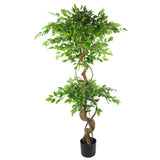
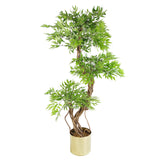
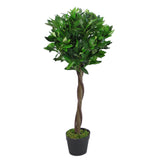
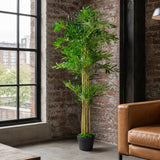
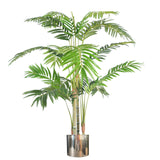
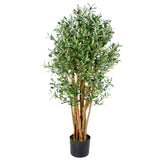
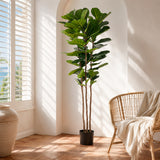
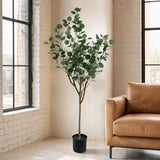
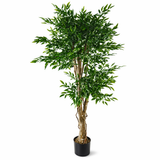
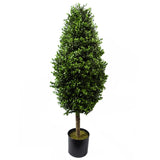
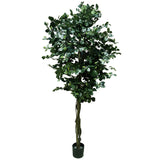
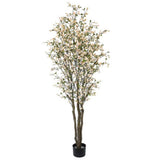
Live prices and stock. Heights are overall, from the bottom of the pot (or of the stem, for stem flowers and ferns) to the top of the leaves. Spreads are as arranged in our photos, and wired stems can be shaped wider or narrower.
Artificial tree species compared
Each species has its own outline, and the outline decides where a tree looks right. Here is how the main types in our range compare.
Olive trees
Narrow, silvery-green leaves on an open, airy canopy give olive trees a light Mediterranean look that suits kitchens, dining areas and living rooms. Our olive trees go up to 250cm, and several have natural wood trunks. The 200cm and 250cm trees come in a decorative planter, so they are ready for a hallway, stairwell or reception as they arrive. None of them are UV-stabilised, so they are for indoor use or a covered spot out of direct sun. Our olive tree guide compares every one.
Ficus trees
Ficus trees range from full, bushy shapes to twisted-trunk Japanese fruticosa-style trees, which are among our best sellers in 2026. They suit living rooms, hallways and offices. Ours run from 45cm to 180cm; one is UV-stabilised and two are fire-retardant grade. See our ficus tree guide.
Fiddle leaf figs
Large, violin-shaped leaves on upright stems make the fiddle leaf fig a bold, modern choice for a living room or bedroom corner. We sell them from 38cm to 180cm. See our fiddle leaf fig collection.
Palm trees
Palms have the broadest, most tropical outline, and many are almost as wide as they are tall, so they need floor space. Our range covers areca, kentia, cycas, phoenix, traveller and more, from 50cm to 260cm, with UV-stabilised and fire-retardant options. Our palm tree guide compares the species.
Bamboo
Bamboo has an upright, vertical shape, so it suits the sides of a window, room dividers and tall corners. Several of our bamboo trees have natural bamboo canes, and they run from 120cm to 200cm. The 200cm natural bamboo tree is fire-retardant grade. Browse our bamboo plants.
Eucalyptus
Soft, silvery-green foliage on slender branches gives eucalyptus a light, relaxed look that sits well in neutral interiors. Our 150cm Premium Eucalyptus Tree has realistic plastic leaves and stems. See all our eucalyptus.
Blossom and flowering trees
Cherry blossom, forsythia and wisteria trees add colour as well as height. Our cherry blossom trees range from 120cm to a 260cm tree supplied with a decorative planter, and the 150cm forsythia has yellow silk flowers on a natural wood trunk. See our flowering trees.
Bay trees and topiary
Clipped shapes such as balls, cones and spirals look formal and work well in pairs, either side of a doorway, a sofa or a bed. Our bay laurel ball trees, with a twisted or a straight natural trunk, are our two best-selling products by number sold in 2026. Several of our topiary trees are UV-stabilised for use by a front door. See our topiary trees.
Other trees
Our range also includes yucca, ruscus, mango, lychee, money and banana trees. Yucca and ruscus both come in UV-stabilised versions, and the 240cm banana tree is one of our largest trees.
Which tree for which space?
Start from the room and the look you want, then narrow down by height. These pairings are a starting point, not rules.
- Living room corner: a 120–180cm ficus, olive, fiddle leaf fig or kentia palm, depending on whether you want sculptural, airy, bold or tropical.
- Kitchen and dining area: olive trees and bay trees suit the Mediterranean mood; keep them clear of hobs and ovens.
- Bedroom: a 90–150cm tree that doesn't crowd the floor, such as a slim ficus or a smaller fiddle leaf fig.
- Hallway or landing: narrow shapes such as bamboo, spiral topiary or a slim twisted ficus, so the walkway stays clear.
- Home office or study: a ficus or bamboo beside the desk, tall enough to be seen above it.
- Reception, hotel lobby or restaurant: 180cm and taller trees, often in pairs, with fire-retardant options where the fire performance of furnishings matters.
- Front door, patio or balcony: UV-stabilised topiary, yucca, ruscus or palms only.
- Conservatory or garden room: treat a sunny conservatory as outdoors and choose UV-stabilised trees; in a shaded one, any indoor tree will do.
For room-by-room ideas, see our guide to artificial plants by room.
Size and ceiling height
Measure from the floor to the ceiling first. As a rule of thumb, leave 30–40cm of clear space above the foliage, and add the height a decorative planter will give the tree. In a room with a standard ceiling, a 150–180cm tree makes a strong floor corner; keep 200cm and taller trees for high ceilings, stairwells and receptions.
Check the spread too. As arranged in our photos, most of our 180cm trees are 60–90cm wide, but some palms and the banana tree are much wider. Our artificial plant size guide explains how to measure, and our large and tall trees collection gathers our biggest trees in one place.
Trunks, leaves and construction
How a tree is made affects how real it looks, especially up close.
Trunks
Some of our trees have real wood trunks, such as the 140cm Japanese fruticosa tree and the 150cm forsythia, and several of our bamboo trees use natural bamboo canes. Others have synthetic trunks shaped to look natural, such as the 150cm twisted-trunk fruticosa-style ficus. Real wood looks the most convincing at close range, so choose it where people will stand next to the tree.
Leaves
Leaves are silk or plastic, depending on the tree, and the product description usually says which. Leaf count is a useful guide to how full a canopy looks, and we include it in the title where we have it: the 180cm fire-retardant ruscus tree has 4,173 leaves, for example. Our guide to the most realistic artificial plants covers the other details to look for.
Branches and assembly
Many of our trees have wired branches that you bend into shape after delivery. Most arrive assembled in a weighted pot, but the largest may need simple assembly: on the 260cm cherry blossom tree, for example, the branches slot onto the main trunk. Our guide to shaping artificial plants after delivery shows how to open a tree out.
Indoor or outdoor?
Only UV-stabilised trees are made for outdoor use, and UV-stabilised products are guaranteed against fading for one year. Our outdoor trees include buxus spirals, cones and ball topiary, a bay tree, cedar cypress topiary, yucca, ruscus, mango leaf and Japanese ficus leaf trees, and traveller and areca palms.
Every other tree is for indoor use or a covered spot out of direct sun. Strong sunlight gradually fades foliage that isn't UV-stabilised, and that includes sun through glass, so avoid a sunny conservatory or south-facing window. See all our UV-stabilised outdoor trees and our outdoor plants guide.
Fire-retardant trees for commercial spaces
For offices, hotels, restaurants and other spaces where the fire performance of furnishings matters, we have trees that are supplied by our manufacturer as fire-retardant (FR) grade. They include the 180cm black olive tree, the 180cm retusa ficus, the 180cm ruscus and lychee ball trees, the 200cm natural bamboo tree, the 210cm phoenix and areca palms, the 210cm cherry blossom tree and the 45cm mini ficus topiary ball. Fire-retardant does not mean fireproof: these trees can still burn. We can supply fire certificates for commercial projects. Contact us for more information.
See every fire-retardant plant and tree, read our fire-retardant plants guide, or visit our trade page for larger orders. For hotels and restaurants, our hospitality guide has more ideas.
Potting and planters
Most of our trees arrive in a weighted plastic starter pot, ready to display, and a few of the largest come in a decorative planter. To finish a tree in a starter pot:
- Choose a decorative planter whose opening is a few centimetres wider than the starter pot, so the pot sits inside rather than on the rim.
- Stand the starter pot inside and pack the gap if it moves.
- Cover the top with bark, gravel or moss to hide the pot.
Our planter size guide helps you match a planter to the starter pot, or you can browse our large plant pots.
One tree, a pair or a group?
A single tree works in a corner or at the end of a sofa, where it has one clear job. Pairs suit symmetrical spots: either side of a doorway, a bed, a sideboard or a reception desk. Choose two of the same tree so the outlines match.
Groups look more natural in larger spaces. As a rule of thumb, combine three trees or plants of clearly different heights, with the tallest at the back, and mix leaf shapes, such as a fiddle leaf fig with a ficus and a low cycas. In offices and restaurants, a line of matching trees can divide a space; allow for the full spread of each tree so that neighbouring canopies just meet. Our guide to styling artificial plants has more layouts.
Common mistakes when choosing a tree
- Putting an indoor tree outside: only UV-stabilised trees are made for outdoor use, and that includes a sunny porch or a conservatory in full sun.
- Checking the height but not the spread: a 150cm kentia palm can spread nearly twice as wide as a 150cm bamboo tree, so compare the widths in the table.
- Forgetting the planter: a decorative planter can raise the tree, which matters under a low ceiling.
- Choosing too small a tree for a large room: a lone 90cm tree can look lost in an open-plan space or reception, where a taller tree or a group works better.
- Leaving the branches as they arrive: trees are compressed for delivery, and a tree that hasn't been shaped looks flat and artificial.
A quick checklist before you buy
- Measure the ceiling height and take off 30–40cm, plus any planter lift.
- Measure the floor space and compare it with the tree's spread.
- Choose a species whose outline suits the room: airy, sculptural, bold, tropical or formal.
- If the tree will stand outside or in strong sun, choose a UV-stabilised tree.
- For a commercial space, check whether you need a fire-retardant tree and ask us about fire certificates.
- Pick a decorative planter a few centimetres wider than the starter pot, and some bark, gravel or moss to finish it.
Light, placement and care
An artificial tree needs no light, water or feeding, so it can go in places a real tree would struggle, such as a dark hallway, a windowless office or a room with no natural light. Our guide to plants for dark rooms has more ideas.
Care is simple: dust the leaves from time to time, and reshape the branches if they get knocked. Keep every tree away from fires, stoves and other heat sources. Our artificial plant care guide has more cleaning tips, and our products carry a one-year warranty.
Products in this guide


Grand Ficus Fruticosa Artificiel Réaliste de 140 cm

Choisissez votre option


Laurier artificiel sur tige - arbre boule topiaire laurier-sauce
Choisissez votre option


Plantes artificielles de bambou Aspect naturel 150 cm (5 pi) – Très grand modèle


Choisissez votre option


Palmier Aréca artificiel de qualité supérieure de 120 cm (4 pi) avec pot


Choisissez votre option


Olivier artificiel de luxe 125 cm - Gamme Premium
Choisissez votre option


Figuier artificiel Fiddle Leaf Premium de 180 cm
Choisissez votre option


Arbre artificiel d'eucalyptus haut de gamme de 150 cm
Choisissez votre option


Arbre artificiel de ruscus résistant aux UV de 140 cm - 2716 feuilles
Choisissez votre option


Sapin artificiel en cône Buxus 120 cm résistant aux UV pour l'extérieur
Choisissez votre option


Olivier noir artificiel ignifugé de 180 cm avec 2925 feuilles et tronc naturel
Choisissez votre option


Cerisier artificiel ignifuge de 210 cm avec 1206 fleurs
Choisissez votre option
Browse by collection
- Oliviers Artificiels12 products
- Palmiers artificiels43 products
- Ficus artificiels37 products
- Bambous artificiels13 products
- Arbres topiaires artificiels20 products
- Déclaration Arbres Artificiels34 products
- Arbres à fleurs artificiels26 products
- Arbres artificiels méditerranéens37 products