

Fire-retardant artificial plants: what the terms mean and what we can document
Fire-retardant (FR) artificial plants are made from materials intended to make them harder to ignite and to slow the spread of flame, but they are not fireproof: they can still burn. Every product in this guide is supplied by our manufacturer as fire-retardant (FR) grade. This guide explains what the terms mean, which standards specifiers ask about, and how to request documentation for a commercial project.
Fire-retardant, fire-resistant and fireproof: what the terms mean
Sellers use these words loosely, but they don't mean the same thing. The difference matters when you are writing a specification or completing a fire risk assessment.
- Fire-retardant (FR): a material that contains, or is coated with, chemicals that make it harder to ignite and slow the spread of flame. It will still burn if it is exposed to enough heat or flame. This is the term our manufacturer uses for the products in this guide, and the term we use.
- Flame-retardant: used interchangeably with fire-retardant for plastics and fabrics.
- Fire-resistant: in everyday speech this often means the same as fire-retardant, and our collection names use it that way. In UK building terms, though, fire resistance means something specific: how long a wall, door or floor holds back a fire, measured in minutes. Fire resistance in that sense doesn't apply to decorative plants.
- A fire rating or classification: the result of a test to a named standard. A rating only tells you something useful when it names the standard, the class achieved and the test report behind it, and when that report covers the product you are buying.
- Fireproof: something that cannot burn. No plastic or fabric plant is fireproof, and ours are no exception.
That is why we describe these products as fire-retardant: it is how our manufacturer supplies them, and it doesn't promise more than the material can do.
Built into the material or applied as a finish
There are two broad ways to make artificial foliage fire-retardant. The retardant can be built into the plastic or fibre when it is made, which is often described as inherently fire-retardant (IFR). Or it can be applied to the surface afterwards as a spray or a dip.
The difference matters to specifiers. A retardant that is part of the material stays in it when the plant is cleaned, while a surface finish can wear away with cleaning and handling and may need renewing.
Our manufacturer supplies the products in this guide as fire-retardant (FR) grade. If your specification needs to know which method was used for a particular product, ask us before you order and we will tell you what information we hold for it.
Fire standards specifiers ask about
The standards below come up most often in UK specifications. We describe them here as general information to help you read a specification: this is not a statement that our products have been tested to any of them. Most were written for building materials, furniture or fabrics rather than for decorative plants, so ask your fire risk assessor or specifier which one they need.
BS EN 13501-1
The European system for classifying how construction products and building materials react to fire, published in the UK as BS EN 13501-1. Materials are placed in classes from A1 (non-combustible) to F, with additional ratings for smoke production (s1 to s3) and flaming droplets (d0 to d2), so a full classification is written in a form such as B-s1,d0. The classification draws on tests including the single burning item test (EN 13823) and a small-flame ignitability test (EN ISO 11925-2).
BS 476 parts 6 and 7
Older British tests for materials used to line walls and ceilings. Part 7 measures how far flame spreads across a surface and places materials in classes 1 to 4, with class 1 the best. Part 6 measures how much heat a material adds to a fire, known as fire propagation. "Class 0" is a classification that older UK Building Regulations guidance defined using the results of both parts.
BS 5852
A test of how easily upholstered seating ignites, using ignition sources that range from a smouldering cigarette and a small flame, roughly equivalent to a match, up to larger burning wooden cribs. It was written for furniture, but it is sometimes used for other decorative products.
BS 5867-2
Flammability requirements for fabrics used in curtains and drapes, with three performance types: A, B and C. Type B is commonly specified for public and commercial buildings.
Supplier paperwork sometimes quotes overseas standards instead, such as NFPA 701 from the United States or DIN 4102 from Germany. Check with your assessor whether they will accept them.
Who decides what your venue needs
In England and Wales, the Regulatory Reform (Fire Safety) Order 2005 requires the responsible person for most non-domestic premises, usually the employer, owner or manager, to carry out a fire risk assessment. Scotland and Northern Ireland have their own equivalent legislation. Decorations, including artificial plants, are part of what that assessment should consider.
So whether a space needs fire-retardant plants, and what paperwork you should keep, is decided by the venue's fire risk assessment, not by the plant. Fire-retardant plants are decorative products: they are not fire safety equipment and are not a substitute for the assessment.
What documentation we can provide
We can supply fire certificates for commercial projects. Contact us for more information.
When you get in touch, it helps to tell us:
- the products and quantities you are considering;
- the type of venue and where the plants will go;
- the standard or classification your specifier or fire risk assessor has asked for, if any;
- when you need the plants installed.
Please ask before you order rather than after, so the paperwork is ready when your assessor needs it. For larger orders, our trade customers page explains how trade accounts work.
Compare every fire-retardant plant and tree
Every product in this table is supplied by our manufacturer as fire-retardant (FR) grade. Sort by height or price, or show only products in stock.
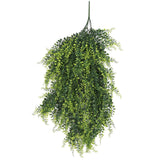
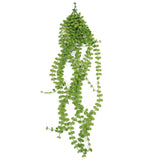
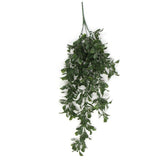
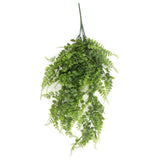
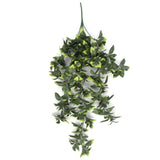
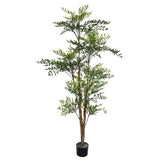
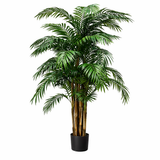
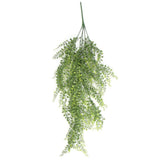
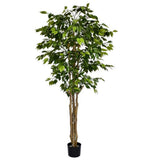
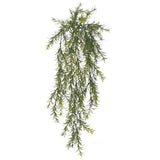
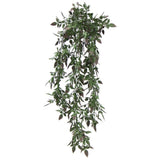
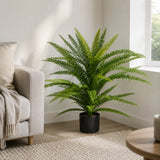
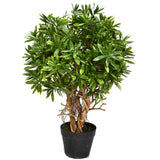
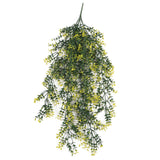
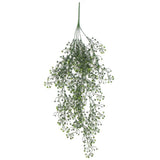
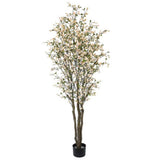
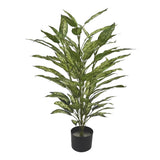
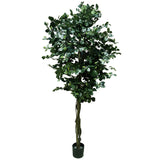
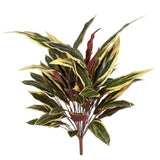
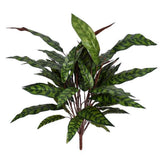
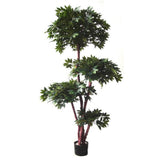
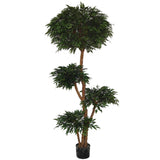
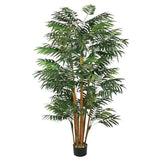
Live prices and stock. Heights are overall, from the bottom of the pot (or of the stem, for stem flowers and ferns) to the top of the leaves. Spreads are as arranged in our photos, and wired stems can be shaped wider or narrower.
The range falls into four groups:
- Tall trees: palms, bamboo, an olive, a ficus, a ruscus, a lychee ball tree and a cherry blossom tree, most of them 180–210cm tall as arranged in our photos. They suit receptions, atriums and lobbies with the ceiling height to take them. Several have natural trunks.
- Potted plants under a metre: a 75cm Boston fern, an 80cm aglaonema bush and a 45cm mini ficus topiary ball, for desks, counters and meeting rooms.
- Foliage stems and bushes, 30–90cm: bare stems for arranging in your own planters, troughs and displays.
- Hanging trailing plants, 68–128cm long: bare stems for high shelves, wall brackets and ceiling installations.
Our 180cm black olive tree is the only fire-retardant tree in our olive range; our artificial olive tree guide compares it with the others.
Which are also UV-stabilised
All of our fire-retardant hanging plants are also UV-stabilised. They include pothos, string of pearls, Boston fern, spider fern, trailing button fern, peperomia and clustered fern designs. That makes them an option for covered terraces, balconies and entrance canopies where a venue wants both properties. UV-stabilised products are guaranteed against fading for one year.
None of our fire-retardant trees, potted plants or foliage stems are UV-stabilised, so keep them indoors or in a covered spot out of direct sun. Our outdoor artificial plants guide covers the full UV-stabilised range.
Where fire-retardant plants are used
Businesses often choose fire-retardant plants for spaces where the fire performance of furnishings and decorations is a consideration, such as:
- hotel lobbies, restaurants, bars and function rooms;
- office receptions, meeting rooms and breakout areas;
- waiting rooms, communal lounges and dining rooms in care settings;
- shops, showrooms and shopping-centre units;
- schools, colleges and other public buildings.
Some people also choose them for their homes because they prefer fire-retardant materials. In every case, fire-retardant plants add to the precautions a building already has; they don't replace any of them.
Planning a scheme with fire-retardant plants
A few practical points help a project run smoothly:
- Don't mix ranges in one display. If an area needs fire-retardant decorations, use fire-retardant products throughout it, including the stems in any arrangement. A single standard stem in a fire-retardant display undermines the point of the display.
- Plan ceiling and wall installations carefully. Our fire-retardant hanging plants and foliage stems are bare stems, so they can be fixed to a ceiling grid, a trellis or a wire frame. Agree the layout with the fire risk assessor before you install it, and keep it clear of detectors, sprinklers and lighting.
- Think about the whole product. Tall trees come in a weighted starter pot. If you put them in a decorative planter, the planter and any top dressing are part of what your assessor will look at.
- Keep the paperwork with the plants. Record which products went where, so that anyone checking the building later can match each plant to its documents.
What designers and specifiers should check
- Ask the fire risk assessor whether the space needs fire-retardant decorations at all and, if it does, which standard or classification they will accept.
- Ask for documentation before you order, and check that it covers the products you are buying rather than a similar line.
- Check which parts of the product the documentation covers. A potted tree has foliage, a trunk, a starter pot and sometimes a top dressing.
- Remember what you add. Decorative planters, moss, bark and gravel are separate items, and they are not fire-retardant unless their own documentation says so.
- Keep plants off escape routes and clear of exits, stairs, fire doors and exit signs.
- Keep foliage well away from heaters, open fires, candles and hot light fittings, and clear of sprinkler heads, smoke detectors and emergency lighting.
- File copies of any documents with your fire risk assessment records, so they are ready for an inspection.
- If you are buying in quantity, order one first to check the size and look in the space.
For hotels, restaurants and bars, our guide to artificial plants for hospitality covers where fire-retardant and UV-stabilised plants fit in a venue. You are also welcome to see the range at our showroom in Louth, Lincolnshire: no appointment is needed Monday to Friday, 8am–4pm, and weekend visits are by appointment.
Shop all fire-retardant plants and trees


Plante artificielle suspendue ignifuge et résistante aux UV 85cm
Choisissez votre option


Guirlande de Perles Végétales Artificielles Suspendues Anti-UV et Résistante au Feu 92cm
Choisissez votre option


Plante artificielle de Peperomia suspendue résistante aux UV et au feu 68cm
Choisissez votre option


Plante artificielle suspendue Pothos verte résistante aux UV et au feu 85cm
Choisissez votre option


Plante artificielle de Pothos suspendue, résistante aux UV et au feu, 71 cm
Choisissez votre option


Nandina artificielle ignifugée de 165 cm avec 4857 feuilles
Choisissez votre option


Palmiste artificiel Areca ignifuge de 210 cm
Choisissez votre option


Fougère artificielle suspendue retombante en forme de bouton de 82 cm, résistante aux UV et au feu
Choisissez votre option


Ficus retusa artificiel ignifuge de luxe de 180 cm avec 1134 feuilles
Choisissez votre option


Fougère artificielle suspendue en bouquet résistante aux UV et au feu 128 cm
Choisissez votre option


Plante artificielle suspendue ignifuge et résistante aux UV, feuillage forestier, 81 cm
Choisissez votre option


Buisson d'Aglaonema Artificiel Ignifugé de 45 cm
Choisissez votre option


Fougère-araignée artificielle suspendue résistante aux UV et au feu 78 cm
Choisissez votre option


Plante artificielle suspendue Angel, résistante aux UV et au feu, 76 cm
Choisissez votre option


Plante artificielle de fougère de Boston de 75 cm en plastique ignifuge avec 49 feuilles
Choisissez votre option


Boule de topiaire artificielle mini Ficus ignifugée 45 cm
Choisissez votre option


Plante artificielle panachée suspendue, résistante aux UV et au feu, 76 cm
Choisissez votre option


Plante artificielle suspendue en perles en cordes, résistante aux UV et au feu, 75 cm
Choisissez votre option


Cerisier artificiel ignifuge de 210 cm avec 1206 fleurs
Choisissez votre option


Aglaonema artificiel ignifuge en touffe de 80 cm avec 72 feuilles
Choisissez votre option


Olivier noir artificiel ignifugé de 180 cm avec 2925 feuilles et tronc naturel
Choisissez votre option


Tige de feuillage artificielle ignifuge mini-feuilles 30 cm
Choisissez votre option


Plante de thym suspendue artificielle à feuilles, résistante aux UV et au feu, 70 cm
Choisissez votre option


Branche de feuillage artificiel ignifuge 78 cm en forme de fougère
Choisissez votre option
Browse by collection
- Commercial338 products
- Plantes artificielles de bureau40 products
- Plantes artificielles suspendues110 products
- Plantes artificielles d'extérieur résistantes aux UV21 products